| On a roll
September 22, 2009 at 6:31 pm
|
| Hallelujah the Hills top themselves with Colonial Drones
When I go bowling with bands, it's usually to extract them from their natural habitat and place them in a controlled environment for study. In the case of my recent bowling date with Hallelujah the Hills, though, my aim was true. I just wanted to bowl.
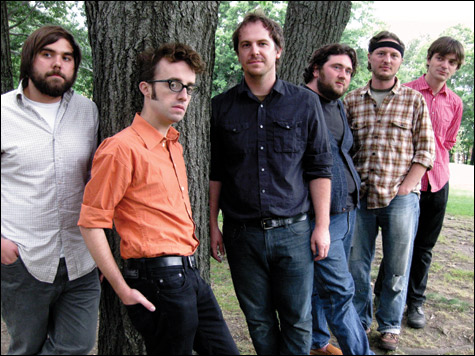
SHAME CHANGER: "It took me a long time to convince myself that everything I was doing wasn't totally embarrassing," says Ryan Walsh (third from left). |
When I go bowling with bands, it's usually to extract them from their natural habitat and place them in a controlled environment for study. Although not exactly sterile, a bowling alley provides a setting wherein communal fun is rigorously tested by individual ambitions — ideal for band observation. In the case of my recent bowling date with Hallelujah the Hills, though, my aim was true. I just wanted to bowl.Our teams were the Rhythm Section (cellist and guitarist David Bentley, multi-instrumentalist and recordist Elio DeLuca, bassist Nicholas Ward, and drummer Matthew Glover — erstwhile of Lights) versus (name not our choice) the Divas (myself, horn player Brian Rutledge and big HTH cheese Ryan Walsh). No wagers were made; the usual competitive machismo that energizes bowling (or ping-pong) seemed quelled by an aura of unity. When Walsh slipped and fell on his ass on his first ball, it came off like a leader yelling, "Charge!" "It took me a long time to convince myself that everything I was doing wasn't totally embarrassing," he tells me on the phone a week later. When he started out writing songs, he'd record little albums, burn them to CD, bang out some artwork, and suffer acute humiliation on reviewing the results. It's like seeing a low total at the end of a string: often you don't feel those gutter balls until you look at the score sheet. It's a strong proverbial bowler who keeps on proverbially bowling. It's hard to imagine these hesitant first attempts, if only because Hallelujah the Hills are (and have been from their beginnings three years ago) one of Boston's most confident-sounding bands. That they've always rolled deep on stage (all those people!) doesn't hurt, but it's their sound that stands out. Pitchforkian shorthand might produce some horrible "Elephant 6 imprisoned in Pollard's basement" fiasco, and it wouldn't be all wrong, but comparisons to other acts shortchange the point. Walsh's voice as a singer and a writer is distinctive. His singing can slip from tremulous neighs to chummy narration; his writing tethers together dozens of disparate rock traditions, new and old, to create a kind of über-Americana propelled by the energy of its own abundance. And as a lyricist, he's as skilled a craftsman of catchy quips as he is a trusty guide into abstraction.
Read more |
| Interview: Jane Goodall
September 22, 2009 at 6:30 pm
|
| Creature comforts
If only there were more trees to be torn down, we could utilize them . . . to fill newspapers with the endless depressing stories out there about the environment and all its hapless inhabitants.
If only there were more trees to be torn down, we could utilize them . . . to fill newspapers with the endless depressing stories out there about the environment and all its hapless inhabitants. The good news is, to break the doom-and-gloom cycle of cynicism, we have Dr. Jane Goodall — internationally renowned primatologist and United Nations Messenger of Peace best known for her study of chimpanzee behavior in Tanzania — to offer a remarkably optimistic point of view in her new book, Hope for Animals and Their World (Grand Central). Hope details how a variety of endangered species have been rescued from the brink of extinction — it's a "you can do it" ecological pep talk. I caught Dame Goodall — who travels 300 days a year advocating for animals — over the phone in New York. In the book, you introduce us to Old Blue, the last-remaining female South Pacific black robin who "saved" her species. The researcher who studied and rescued her has an approach that seems to reflect your own philosophy, which has been controversial in scientific circles in that it anthropomorphizes animals.
That's my favorite story ─ that set me off on this whole track! I met Don Merton a long time ago. And that story is soooo amazing. And that man is such a lovely man. You know, he loves those little black robins. And he's not ashamed of saying he loves them. It's not so much anthropomorphizing, but it's that one should be totally objective and you shouldn't have any empathy with your subjects, and you shouldn't give them names, and they can't have personalities, and they ought to be numbered, and they don't have feelings. But, of the amazing people that I've talked to in writing this book, I haven't found any who actually felt that. Sometimes they felt they ought to put that front out in order to get funding. But down underneath, they care passionately about their animals. And a lot of them will actually admit it. If they've retired ─ they're very happy to admit it then!
Read more |
| Soul training
September 22, 2009 at 6:20 pm
|
| Suddenly, Mayer Hawthorne is running retro-pop
Mayer Hawthorne rose to instant retro-pop acclaim the same way that everyone from Al Green to Michael Jackson moved on up — work and luck.
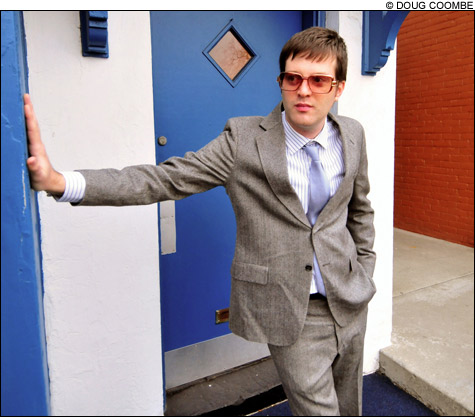
WHO'S THE NEW GUY?: Mayer Hawthorne doesn't pack the vocal prowess of Boston's own white-soul survivalist Eli Reed, but his music is years more contemporary. |
Mayer Hawthorne rose to instant retro-pop acclaim the same way that everyone from Al Green to Michael Jackson moved on up — work and luck. A long-time DJ who was born in snow-white Ann Arbor, he left home to seek hip-hop fame in Hollywood after outgrowing Detroit's rap scene. Once out West, he recorded two soul tracks that he planned to share just with friends, but they wound up wowing Stones Throw owner Peanut Butter Wolf and Amy Winehouse producer Mark Ronson, both of whom helped establish him as new black music's unlikely alt hero. Pretty standard, really, but still a huge surprise to the Motown native, who comes to Great Scott on Tuesday. "This all just happened last November, so I had to drop everything in order to become Mayer Hawthorne," says the renaissance talent born Drew Cohen. "Even the [stage] name was sort of last-minute. Mayer Hawthorne is really my porn name: 'Mayer' is my middle name and 'Hawthorne' is the street that I grew up on. For whatever reason, though, this whole thing has caught on, and now it's out of my control." Although unlikely, Hawthorne's rise wasn't quite as unbelievable as some on-line rumor mills have suggested — he wasn't an obscure shut-in making laptop rock in his Underoos. As DJ Haircut — before he donned a cardigan and dropped the universally adored single "Just Ain't Gonna Work Out" — the vinyl-minded turntablist/producer racked up props and paychecks, both as an A-list Sunset Strip party jockey and as a member of Detroit's well-regarded Athletic Mic League (alongside Buff 1) and his electro-soul squad, Now On. He was even represented by the all-powerful Agency Group, and it seems he knew the right people who knew the right people. "These songs were experiments for fun on the side," he says of his secret jam sessions. "They were for me to see if I could really do it. At first, I only had two songs, and no plans to do more, when I played them for a friend who knows Peanut Butter Wolf. After that, when she introduced me to Wolf and didn't say anything about my hip-hop stuff, I was like, 'Cool — thanks for shopping songs that I didn't even want anybody to hear.' But then he wrote me about a month later asking where I dug up these old records. When I told him that was me singing and playing all of the instruments in my bedroom, he flipped out and asked if I would do a whole album."
Read more |
| Review: Darkest of Days
September 22, 2009 at 4:30 pm
|
| Time travel's last stand?
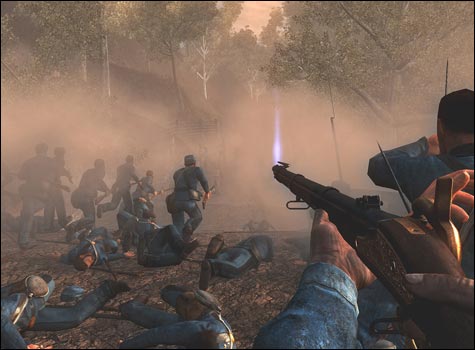
In Darkest of Days you play as Alexander Morris, a soldier fresh from Little Big Horn. Right after you get nailed with some feather-tipped arrows, KronoteK rushes in to "save" you. There's a catch, though: you then go to work for KronoteK.
The list of games that include time travel is mighty short, and the list of games that use the device effectively is even shorter. Off the top of my head, there's Ocarina of Time, and . . . well, I told you the list was short. So it was a bit puzzling to learn that 8monkey Labs decided to use this complex and delicate plot device in their first "big" video-game release, Darkest of Days. In Darkest of Days you play as Alexander Morris, a soldier fresh from Little Big Horn. Right after you get nailed with some feather-tipped arrows, KronoteK rushes in to "save" you. There's a catch, though: you then go to work for KronoteK, a futuristic research team with a time machine that tracks down soldiers on the point of death, abducts them, and forces them to spend the rest of their lives in the company's employment. You'd think they'd give you a staggering futuristic arsenal, but no, they want to make sure you don't stand out, so they doom you to a life reliving dangerous battles with substandard weaponry. Darkest of Days recreates notable battles of times past. The player uses historically accurate weaponry in famous fights like the Battle of Antietam and the Battle of Tannenberg. Sounds awesome, right? You must not have been listening: historically accurate weaponry. There's a reason games don't include scenes from the Civil War: the guns sucked. You'll spend more time watching the achingly slow reload simulation than you will shooting, not to mention that your shots won't fire straight. You can aim right at a guy and your unreliable bullets won't hit their mark, just like a real American soldier in 1862. Having fun yet? You're purportedly fighting in these tedious battles for the sake of recording history (with a camera? It's never clarified), and you are instructed not to change the past. For example, characters who you aren't supposed to kill are illuminated with blue light; you can shoot them in the legs if you need to incapacitate them. However, you are also told that these missions are "emergencies" and that you have to "save" the battle and make sure it goes the right way -- for example, at Tannenberg, you have to make sure that the Nazis don't win. If you think about that directive for longer than one second, you'll remember that all of the battles have already happened and there's no real "emergency." Eventually, some rogue agents who've obtained KronoteK technology show up and start interfering with your missions. Around this point, you might think you're finally getting to the good part of the game, but you'd be wrong. I won't spoil it for you except to say that the game's denouement is as unsatisfying as its historically accurate artillery (seriously, whose idea was that? How did that one get past the brainstorming phase?).
Read more |
| Review: Tom Russell | Blood and Candle Smoke
September 22, 2009 at 4:25 pm
|
| Shout! Factory (2009)
This LA-born troubadour with a Dustbowl voice works voodoo on his 24th studio album, conjuring ghosts of the '60s and '70s along with apocalyptic visions as he relates tales of gun-toting madmen and dark rifts of the heart. |
| Photo: Damian Ortega at ICA
September 22, 2009 at 4:20 pm
|
| Damian Ortega's Do It Yourself exhibit at the ICA, September 18, 2009 - January 18, 2009
Photos of Damian Ortega's Do It Yourself show at the ICA

Photo: Melissa Ostrow
Damian Ortega: Do It Yourself | Institute of Contemporary Arts | September 18, 2009 - January 18, 2009
Read more |
| Review: Muse | The Resistance
September 22, 2009 at 4:04 pm
|
| Warner Bros. (2009)
English rock trio Muse here attempt a rock opera. |
| Review: Bebe Gilberto | All In One
September 22, 2009 at 3:14 pm
|
| Verve (2009)
There couldn't be a more apropos title than the one Bebel Gilberto has given her fourth album. |
| Fool's Gold | Fool's Gold
September 22, 2009 at 2:52 pm
|
| Iamsound (2009)
A big band with a big sound, Los Angeles-based Fool's Gold come off as self-consciously cosmopolitan. |
| Eno Moebius Roedelius | Cluster and Eno/After the Heat
September 22, 2009 at 2:47 pm
|
| Bureau B (2009)
Krautrock pioneers proved much more simpático musical partners than either the fractious Roxy Music or the British classical avant-garde milieu that thought of Eno as an untrained fanboy. |
| Interview: Robert Siegel
September 22, 2009 at 2:11 pm
|
| On the shoulders of Giants fans
As Robert Siegel explores the idea of what happens when reality curb-stomps overblown expectation, it's hard not to feel a visceral twinge of empathy.
.jpg "interview-RSeigel_main2") Big Fan director Robert Siegel (right) with Patton Oswalt (left) |
Big Fan is the kind of movie that taps directly into my lizard brain, stirring up bits of primal dread. By which I mean to say Big Fan is a gut-wrenchingly great film. The directorial debut of screenwriter Robert Siegel (the Onion's former editor-in-chief who also wrote the screenplay for The Wrestler), Big Fan stars comedian Patton Oswalt as Paul, an arrested-development working stiff whose fervor for the NY Giants verges on religious mania and whose awe of fictional linebacker Quantrell Bishop resembles an adolescent crush. When Paul follows Quantrell into a strip club, the athlete freaks out and unloads a savage beating on his fan, bruising his brain and shattering his world. As Siegel explores the idea of what it means to inflict your presence on your personal idol, and what happens when reality curb-stomps overblown expectation, it's hard not to feel a visceral twinge of empathy. Last week, I accosted Siegel via phone, and we got a little meta.
So, Big Fan -- what a jolly way to kick off football season.
Some people, it puts them in the mood for football. Other people it depresses. Are you a football fan?
No, I'm not. But the film really touched a nerve. So, I've read that Darren Aronofsky was originally interested in Big Fan before you both collaborated on The Wrestler. Was he?
Yes. That's how I met him, through Big Fan. The script just kind of floated around Hollywood and made its way to various people's desks. And somehow it reached him, and he liked it, and we met a bunch of times about it. ... And he wound up not doing it for various reasons. You know; shit happens. But he called me up, maybe a few months later, and he asked if I had any interest in doing a movie about a wrestler. And I said, "Definitely." I think when he read Big Fan, I guess he just thought I would be a good fit for it.
Well, Big Fan does feel like the flip side of The Wrestler, or vice versa -- one's about the perils of being the athlete, and the other's about the perils of being the fan.
Yeah, in that way, it is. It's kind of simultaneously the flip side and a companion piece. In that they [Patton Oswalt's Paul in Big Fan and Mickey Rourke's Randy in The Wrestler] are both guys that are kind of on the fringes in their own way ... I guess they're both outsiders, in that one is an outsider among fans and the other is an outsider among athletes.
I read that you started out writing screenplays in more of a Will Ferrell-type comedy vein.
Yeah, I tried comedy, just because I thought that's what I was supposed to do. Being a comedy writer by trade, I thought I'm supposed to write comedy, which seemed logical at the time. But the pages were -- they were OK; they were nothing special, though ... But then this one, I just came up with this idea through the comedy. It [Big Fan] could have been a comedy. There's probably a comedy version of this. But I always saw it as a dark drama and kind of a dark character study. It felt like something clicked that hadn't clicked before, in terms of finding my voice.
Did Big Fan deviate from the original script at all?
It's basically the same. The only significant change was that there was kind of a half-assed love subplot. He meets a girl, and it was a little like in Punch-Drunk Love -- a "these two misfits" kind of thing -- and it wasn't necessary. It was a distraction. Every time I got to those parts of the script, it felt like I was hitting a commercial break in the movie, and you just wanted to get past it. And, really, the movie didn't need a love story because it already had one, which is the love story between Paul and Quantrell.
Which is wonderful and sort of uncomfortable. Very uncomfortable. Profoundly uncomfortable, actually.
Some people just think it's funny. I don't know, it gets very different reactions. Some people just think it's like, "Hey, I totally know that guy, and it's funny." Sports fans tend to have a less complicated reaction to it. They just think it's kind of fun and relatable and weird. But more artistically minded individuals tend to find it more crushingly depressing.
To call back to the Onion: for me, the sheer torture of certain aspects of Big Fan reminds me of Jean Teasdale columns. I love them, but oh my God, I can barely make it through them.
Exactly. It's funny. I love Jean.
Did you ever write Jean?
No. I used to write Smoove B. No, Jean was written by Maria Schneider, who's not there anymore, but she was at the Onion for years and years. But I'm glad you like Jean. A lot of people ask, "What is the connection [between the Onion and Big Fan]? Where does this come from? Somebody who used to write comedy?" But the Onion has a lot of dark undercurrents. And this is kind of the cinematic version of an "Area Man" story. The Onion's staple of "Area Man Does Such-and-Such" that makes you want to kill yourself. It all makes perfect sense to me.
When you wrote Big Fan, did you have Patton Oswalt in the back of your mind for the role of Paul?
Did I have him in the back of my mind? No. Well, I had a guy who looks and sounds exactly like him in the back of my mind, but I didn't put the name Patton to it at the time. I mean, I knew of Patton; I'd been a fan of his for many years. But I didn't really ever think about real-world people at that point. I definitely pictured a guy who looked remarkably like Patton. And then it was years later before I actually started thinking about casting, and it wasn't long before I got to Patton.
You did an interview where the person you were talking to had a great line about Paul -- something to the effect of: "We all know 'that guy,' but none of us are that guy."
Yeah. To date, no one has fessed up to being him. At any screening that I've done Q&A's at, people come up to me afterwards, and they all say they know "that guy." Which either means they're in denial, or "that guy" just doesn't leave the house.
Where did this film come from? Did it come from any particular experience that you had had? I think everyone must have a story involving a disappointing encounter with a celebrity.
I've taken pains to avoid any such encounters ... Years ago, I was at the Vatican, at the Sistine Chapel, during my first-ever trip to Europe, and I saw Bruce Springsteen there. He was there on family vacation with Patti and the kids. And Tom Hanks and Rita Wilson were there with their kids. Which, in retrospect, is crazy because it was just like The Da Vinci Code, seeing Tom Hanks at the Vatican, but this was before The Da Vinci Code. Your first impulse is to go up to the person and say, "I'm your biggest fan." But they get that all day long. And there's really no way to satisfyingly prove that you actually are in fact their biggest fan -- except by doing something uncomfortable and awkward and psycho, like pick the most obscure Springsteen song and recite all the lyrics. And what does that accomplish? There's nothing to be gained. I could only annoy or piss off my hero, and I would walk away the rest of my life feeling like Bruce Springsteen thinks I'm a douchebag. What is the possible positive outcome of approaching him? There's no time to convince him. He doesn't want to be convinced. He gets this all day long. I'm probably not his biggest fan, also, even though I think I am. So I just have the good sense to stand in line behind him. I mean, I hovered for quite a while. But I had the good sense not to say anything to him.
Yeah, that's a huge fear of mine -- blowing a celebrity encounter the way Paul did in Big Fan. So for me, the movie felt a lot like a horror movie. Like, "Don't go in there!"
Exactly. But then there would be no movie. Well, who would be your hero?
Well, actually, I was kind of relieved that Patton Oswalt was not available for an interview. I was thinking, "God, I'd love to talk to Patton, too." But as I was thinking it over, I realized I was terrified that I'd say something to make him hate me, and then I could never enjoy Patton Oswalt again.
He's very, very sweet. Unless you're, like, a movie-junket cheeseball. Those people he has no tolerance for.
Oh, I don't mean to insinuate anything. I just had a moment of uncontrollable dread. Anyway, it's funny that you brought that up.
I interviewed Paul McCartney last year for the Onion. At the last minute, they called me and said he was in New York for a couple days doing press for his album, and they needed somebody to interview him in person, and they called me on, like, 10 minutes' notice. At first I said no ... but I did it, just because he has this reputation of being an insanely nice guy. So I did it, and it was great. I took pictures with him and had a great interview with him. But I only did it because -- well, I would not have said yes to Lou Reed on short notice, because that would have been terrible. He would have been a dick to me.
Read more |
| No new age
September 22, 2009 at 1:51 pm
|
| Earthsound is for real
Yes, this Boston jazz trio incorporates the sounds of seals, tree frogs, and crickets. Yes, one of them is a working ecologist. Here's why you shouldn't hold that against them.
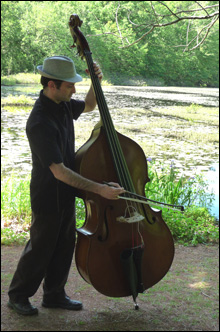
FOUND SOUND: Jason Davis's jazz is "earthy" in more ways than one. |
All the external trappings of Earthsound suggest new age, beginning with the band's name and extending to phrases in the liner notes of their album Movement about "the barriers between human culture and the natural world" and "seals recorded underwater in Antarctica." Eeek!But the names of the players tell another story: flutist Fernando Brandão, pianist Nando Michelin, drummer Jorge Pérez-Albela — all esteemed jazz musicians on the local scene. The most convincing argument is made by the music itself: beautifully played, vibrant jazz, often based on the most demanding — and "earthy" — of folkloric idioms: Brazilian choro, Peruvian waltz, and Turkish belly dancing music. And yes, there are the voices of the occasional tree frog, but more on that later. "For sure, part of my goal with this project is to avoid the new-age cliché," says the bassist and leader of Earthsound, Lexington native Jason Davis. "I have nothing against it. Paul Winter is great. But I really want this to come from the jazz tradition, and world music like Brazilian, and not water it down at all but make it real music." No questioning the "real" part. The album opener, the Davis original "Ariane," is a driving samba, with Brandão, Michelin, and Davis all picking up on the melody-as-rhythm theme in their solos. The same goes for composer Felipe Pinglo's Peruvian standard "El Plebeyo," its particular vals criollo rhythm leading to an extended elaboration by the band and a feature for Davis's distinctive bowing. Four of the 12 pieces on the CD feature Earthsound improvising with ambient field recordings. In "Summer Lake," Davis bows against the rhythms and pitches of frogs and crickets. "Monteverde Slow" has Michelin responding to the dense multifarious sounds of a Costra Rican rain forest. "Hermit Thrush," has Brandão "singing" along with that North American bird. And in "The Seals," Davis bows long tones and then faster rhythmic figures alongside the eerie clicks, sucks, and whistles of those Antarctic underwater mammals. "The first time I heard that, I said, 'What is that?" says Davis of the seals when we get together for lunch on the back patio at Audubon Circle. "I couldn't believe it was a natural sound. And I love that. I love hearing a sound people don't associate with 'nature' — and it's almost electronic!" In live shows, Davis triggers the field recordings with an iPod and calls out individual band members to improvise. "Nando has perfect pitch — he can hear a bird call and turn it into a motif to improvise off." Michelin's rhythmic, harmonically layered response to the rain forest suggests a combination of bird-loving modernist classical composer Olivier Messiaen and Bill Evans.
Read more | | | 
|


No comments:
Post a Comment