| Review: Disgrace
September 23, 2009 at 6:47 pm
|
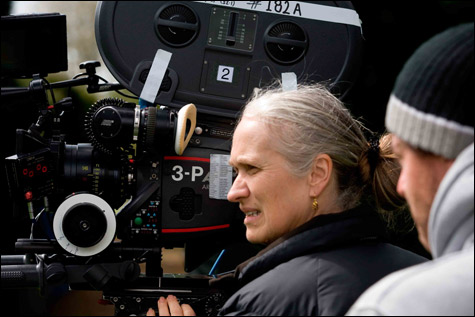
| Jacobs's adaptation of Coetzee's novel plenty disturbing
Australian filmmaker Steve Jacobs's adaptation of South African writer J.M. Coetzee's 1999 novel doesn't add much clarity to the debate on race in America, but it's plenty disturbing. |
| Bookstores fight back with instant paperbacks
September 23, 2009 at 6:32 pm
|
| Just Add Author Dept.
Battered booksellers, especially independent ones, have so far withstood the punishing shock-and-awe offensive of Internet Age marauders like Amazon.
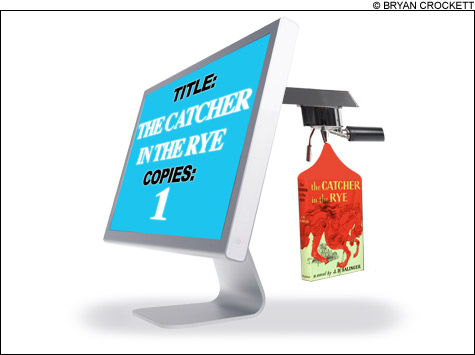
Battered booksellers, especially independent ones, have so far withstood the punishing shock-and-awe offensive of Internet Age marauders like Amazon. Now, they have a secret weapon that they hope will continue to lure customers into their stores: would you believe it's a machine that can print up a fresh new paperback copy from a menu of 3.6 million books? Harvard Book Store cleared out space behind its History, Politics, and Religion sections to make room for the three-foot-by-six-foot-by-four-foot robot retailer, called the Espresso Book Machine. In a public unveiling slated for September 29, the Harvard Book Store will become only the second US merchant to install such an apparatus, which prints, binds, and trims perfect-bound books — complete with full-color covers and black-and-white guts — in about four minutes. "Books will be produced on a massively decentralized way," promises Dane Neller, CEO of On Demand Books, the manufacturer of the machines that will let customers select from millions of titles in less time than it takes to comb the teetering stacks of a used bookstore. "The life of the book will be infinite." Says Harvard Book Store owner Jeffrey Mayersohn, "I had developed a notion that the ability to produce books in stores was an important part of the future of bookselling." So is having access to an inventory that rivals the depths of the Amazons. With the machine comes a deal inked this month between Google and On Demand Books, which gives patrons access to more than two million public-domain and out-of-print titles in Google's digital coffers, coupled with 1.6 million others. "We're moving steadily toward the goal of any book, ever written, in your hands, in a moment," says Mayersohn. With production and order fulfillment gone local (and Harvard adding its own bicycle-delivery twist), this could be a leaner, meaner, and greener economic model than centralized book production and distribution with the biggies — but only if enough readers demand sufficient obscure titles, at $8 a pop, to pay for the $100,000 machine. "I personally don't know how far this is going to go and how much the economics are going to work for the booksellers," says Tom Hallock, associate publisher and sales and marketing director of Boston's Beacon Press. Nonetheless, he says it's important for brick-and-mortar stores to stay in the game: "I applaud the Harvard Book Store for bringing in the machine and seeing what they brew up with it," even if in-store printing competes with trade publishers like his.
Read more |
| Failed fall pilots
September 23, 2009 at 6:29 pm
|
| Big Fat Whale
Dowdy old lady town |
| Holy landscape!
September 23, 2009 at 6:27 pm
|
| Ken Burns worships America's spiritual resource
At its core, Ken Burns's PBS 12-hour epic The National Parks: America's Best Idea (nightly on WGBH Channel 2 at 8 pm, from September 27 through October 2) is a selective, initiative by initiative, advocate by advocate, chronicle of the evolution of the National Parks system and the changing roles protected lands have played in American culture since Congress validated Yosemite in 1864.
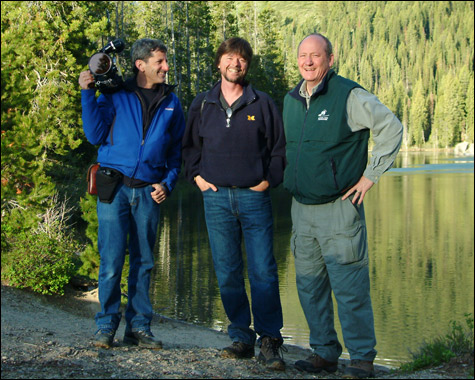
PANTHEISTIC CONNECTION: Long before environmentalism, John Muir extolled the virtue of spaces where "nature may heal and give strength to body and soul." |
At its core, Ken Burns's PBS 12-hour epic The National Parks: America's Best Idea (nightly on WGBH Channel 2 at 8 pm, from September 27 through October 2) is a selective, initiative by initiative, advocate by advocate, chronicle of the evolution of the National Parks system and the changing roles protected lands have played in American culture since Congress validated Yosemite in 1864. Written by Dayton Duncan, the film does the job of telling that story well, despite focusing on only a double handful of sites (though all are depicted) and "a few" (that is, "just" 60 or so) of the players in the struggle to establish protected public lands.Beautiful? Of course, it's beautiful. Burns, after all, filmed the same dramatic landscapes gorgeous enough to inspire a profit-obsessed, expansionist-minded nation to preserve natural settings for future generations. As he reminds us, the initial motivation behind such set-asides was more spiritual than scientific. Logical arguments for protecting wilderness based on the environmentalists' long view and calculated ecological management came late to this party. In the 19th century, the sales pitch was based on æsthetics and a plea to restore the pantheistic connection between modern, industrializing society and Eden. Naturalist John Muir, the parks movement's primary early advocate, certainly had a head for science, but he buttressed his case with transcendental arguments like "Everybody needs beauty as well as bread, places to play in and pray in, where nature may heal and give strength to body and soul." Muir understood that what moves the spirit is not only the impressive foreign spectacle of a primordial vista but the humbling fact that such a souvenir from unimaginable æons past can exist in the present. As usual, Burns inserts interviews by writers and participants that, occasional repetitions aside, place the history in meaningful perspective. Prime among these is his unintended "star," African-American ranger Shelton Johnson, who's brought into the mix only to comment on the period when black cavalry, the "Buffalo Soldiers," patrolled the parks. Johnson, it turns out, is also a poet and the production's most eloquent, silver-tongued recurring spokesperson. Burns calls him "the conscience of the film."
Read more |
| Review: Amreeka
September 23, 2009 at 6:25 pm
|
| Cherien Dabis's feature debut is winning
In the finely sketched beginning chapters of Arab-American writer/director Cherien Dabis's feature debut, we share the frustrating, claustrophobic life of our heroine, Munah Farah. |
| Photos: The National Parks: America's Best Idea
September 23, 2009 at 6:11 pm
|
| Images from Ken Burns's latest documentary
Scenes from The National Parks: America's Best Idea , a six-part, 12-hour film by Ken Burns and Dayton Duncan, George Masa.

As revealed in The National Parks: America's Best Idea, a six-part, 12-hour film by Ken Burns and Dayton Duncan, George Masa (pictured here photographing the Great Smoky Mountains), a Japanese immigrant, helped the crusade to create Great Smoky Mountains National Park with his scenic photographs of the region. Credit: George Ellison. READ: Holy landscapes! Ken Burns worships America's spiritual resource. By Clif Garboden.
LISTEN:Clif Garboden's interview with Ken Burns.
Read more
|
| MassCan's 20th Freedom Rally relatively free from arrests
September 23, 2009 at 6:06 pm
|
| Peace Pipe Dept.
Assuming that, at MassCann's 20th annual Freedom Rally on Boston Common this past Saturday, all 30,000 attendees got stoned, smokers had less than a half-percent chance of getting busted. |
| Rino's Place
September 23, 2009 at 5:58 pm
|
| Old-school, groaning-platter Italian-American meets authentic Italian in Eastie
I often chat up local chefs about their favorite restaurants, usually over drinks at late-night watering holes. |
| The Stork Club
September 23, 2009 at 5:56 pm
|
| Jazz and soul team up to make sweet music
Remember Circle: Plates and Lounge? The Stork Club has succeeded that short-lived restaurant and bar, which succeeded Bob's Southern Bistro, itself the recast version of Bob the Chef's.
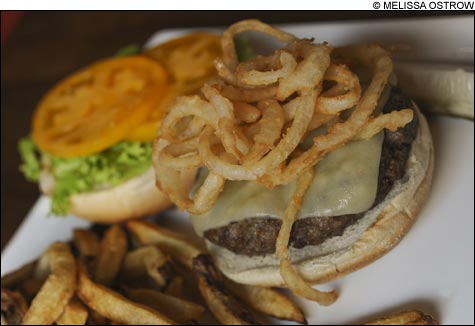
THE BURGER IS KING: A house-made Angus burger, topped with onion rings, quality cheese, and optional meaty, smoky bacon, is the stunner of the entrées. |
| The Stork Club | 604 Columbus Avenue, Boston | 617.391.0256 | Open Daily, 5:30 pm –1 am | AE, DI, MC, VI | Full bar | No valet parking | Access up two steps from sidewalk level |
Remember Circle: Plates and Lounge? The Stork Club has succeeded that short-lived restaurant and bar, which succeeded Bob's Southern Bistro, itself the recast version of Bob the Chef's. Some token soul food remains on the menu here, but we have clearly jumped from Boston's leading African-American-owned restaurant to a jazz-inspired nightclub/restaurant named after a famous New York hotspot that, while not technically segregated, was notoriously inhospitable to black celebrities.The food, while a bit busy and on my visit sometimes over-salted or overly reliant on hot pepper, is generally fine. It's a pleasant place for an early dinner, though the live music (mostly jazz) doesn't start until 8 or 9. The bar-type menu is a fine match for music, too. If your clothes aren't too jazzy, you could risk the yellow-tomato gazpacho ($8), an excellent version of the acidulated raw soup with pretty swirls of basil oil and bit of cream at the center. A salad of arugula, roasted figs, caramelized walnuts, and shaved parmesan ($10) worked despite all those disparate ingredients ? the cut-up figs seemingly fresh, the walnuts perhaps not so caramelized, the dressing excellent. Rock shrimp and ginger spring rolls ($13) were unfortunately too stodgy and the flavor of Maine rock shrimp was lost. With two dips (soy and citric), this dish could be fixed, perhaps by a consultant from Southeast Asia. Spice-cured country ribs ($12) were just eight baked ribs in the Boston style, meatier and neater than at either version of Bob's, but in reasonable solidarity. The sauce, "Prickly Pear BBQ," doesn't taste like cactus, but does taste peppery, so okay. The stunner of the entrées was the handmade Angus burger ($12; add $1 for bacon). It comes with excellent French fries ? tops, in fact, in every category except crispness ? that are truffle seasoned and taste like real potatoes. The chef is smart enough not to make the ketchup from scratch. Do have the bacon, which is thick, meaty, smoky, and crisp.
Read more |
| Crossword: ''Remember the date''
September 23, 2009 at 5:47 pm
|
| We'll make it three times as easy for you.
We'll make it three times as easy for you. |
| The Interview
September 23, 2009 at 5:34 pm
|
| Hoopleville
What makes you so special? |
| It's too nice out to think
September 23, 2009 at 5:32 pm
|
| Failure
I love this time of year! |
| Review: Paris
September 23, 2009 at 5:28 pm
|
| What's the French word for Crash ?
Cédric Klapisch's serendipitous interweaving of the lives of disparate characters in the title city never resorts to the contrivance and manipulation of Paul Haggis's Oscar winner, but there are some close calls. |
| Review: Five Minutes of Heaven
September 23, 2009 at 5:23 pm
|
| Or, rather, 90 minutes of tension
It's easy to see what attracted Liam Neeson and James Nesbitt ( Bloody Sunday ) to Prime Suspect veteran Guy Hibbert's screenplay: it's an actor's showcase. |
| Can Beacon Hill do better?
September 23, 2009 at 5:21 pm
|
| Gambling and education take center stage
With DiMasi gone, the idea of casino gambling is again alive.
Last year the Phoenix came out foursquare in favor of Governor Deval Patrick's plan to build resort-style casinos. Patrick's proactive plan was conceived as a solid economic-development project closely tied with promoting tourism, already the state's third-largest industry. Former Speaker of the House Sal DiMasi, now under federal indictment on charges of political corruption, killed the idea. With DiMasi gone, the idea of casino gambling is again alive. After taking the temperature of his chamber, current Speaker Robert DeLeo has flip-flopped and is letting planning go forward. Why is what was a bad idea one political season ago now a good one? Part of the answer is that, with the economy in the tank, the state is more strapped for cash than usual. The other part is that, as a group, Beacon Hill legislators — especially House members — often have a hard time telling their heads from their tails. A bunch of bananas has more spine than the House — and often more foresight. The way things are shaping up at the State House, there is a good chance that any casino bill will be a thinly disguised measure to save horse racing, which is having trouble maintaining its economic viability. One of the strongest arguments in favor of Massachusetts casino gambling is to try to capture a portion of the estimated $1 billion in local dollars that flow to casinos in Rhode Island and Connecticut. But anyone who thinks casino gambling will be a magic pill to solve this state's fiscal woes should take a look at what's happening south of our border, where the bad economy has cut into gaming profits, and thus revenue to the states of Rhode Island and Connecticut. Rhode Island did a particularly bad job of structuring its gaming business. If Massachusetts is not careful, it is possible that it could turn what should be a winning proposition into a losing one. A new look at casino gambling should take into account the current economic climate. If there is a new case to be made, make it. But forget about bailing out the race tracks. Let's see if the legislature can redeem its dismal record on this matter and come up with a plan that makes long-term sense. A sorry statistic
You wouldn't guess it from DeLeo and Senate President Therese Murray, but there are more pressing issues for the state legislature than casinos. Education, for example.
Read more |
| Review: Love Happens
September 23, 2009 at 3:28 pm
|
| Melodrama also happens
Half an hour into the screening of this tearjerker from Brandon Camp, three women exited. They made the right choice. |
| You're all guilty!
September 23, 2009 at 3:17 pm
|
| In his new book, Three Felonies a Day , Harvey Silverglate dissects the corrupt justice practiced by federal prosecutors
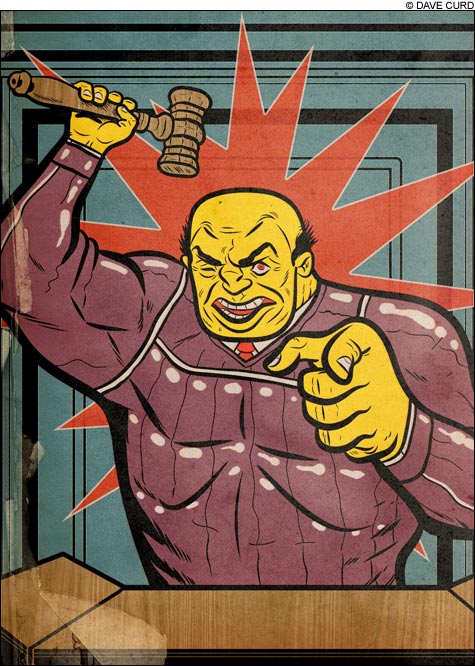
Silverglate's thesis is as provocative as it is simple: justice has become sufficiently perverted in this nation that federal prosecutors, if they put their minds to it, could find a way to indict almost any one of us for almost anything. It is a truly radical notion.
Harvey Silverglate is a difficult talent to pigeonhole. A combative criminal appellate and trial lawyer, he has dedicated himself to defending civil liberties in their broadest definition. In the process, Silverglate has carved out a special reputation as a scourge of campus-based "political correctness," and has won numerous awards for his long-standing legal and political coverage in the Phoenix. Now, he has published his second book, Three Felonies a Day: How the Feds Target the Innocent (Encounter Books, $25.95). Silverglate's thesis is as provocative as it is simple: justice has become sufficiently perverted in this nation that federal prosecutors, if they put their minds to it, could find a way to indict almost any one of us for almost anything. It is a truly radical notion. Silverglate presents a series of freestanding case studies that range from Wall Street to the Massachusetts State House, to Boston City Hall, to a suburban doctor's office, to a Midwest university, to the newsroom of the New York Times. At this curious moment in history, Silverglate's book might not shock either the left or the right. For some time now, the two opposing wings of the American centrist polity have been alarmed by the predatory nature of our national government. For those in the middle of the political spectrum, however, Silverglate's book should be a bracing wake-up call. Liberty and freedom are being compromised, one prosecution at a time. Your book was written during the Bush years. But now, Barack Obama is president. Why should the concerns you lay out inThree Felonies a Daystill be on progressive minds? The big, bad Bush Republicans are gone.
You raise an interesting point. A lot of my liberal friends assume that my book is about prosecutions under the eight years of Bush. This, however, is not a phenomenon that is relegated to any particular political party. The abuses are found under every president from Reagan to today. Including Clinton and Obama?
Under Clinton, yes. And I see little reason to think that they will not continue under Obama. Pinpoint when prosecutors began running amok.
The mid 1980s. That's when I began to notice this phenomenon. I have been a criminal-defense and civil-liberties lawyer from 1967 onward, so somewhere short of two decades into my legal career is when I noticed this problem.
Read more |
| The Olympic (shell) games
September 23, 2009 at 3:05 pm
|
| There are billions of reasons why every debt-saddled American should hope that the US does not get the gold in 2016.
It's been 13 years since the pageantry and spectacle of the Summer Olympic Games — and the mythical economic boon that goes with it — has graced US soil. But we'll find out next week if, in a secret-ballot vote in Europe, the International Olympic Committee (IOC) will award the 2016 Games to Chicago, the American city competing for the bid.
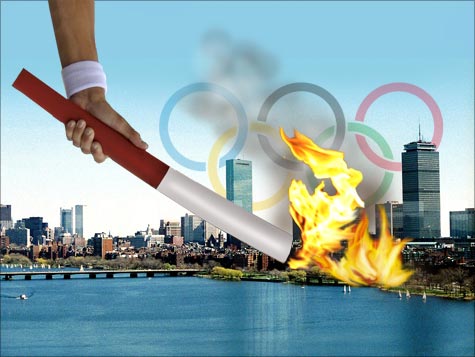
It's been 13 years since the pageantry and spectacle of the Summer Olympic Games — and the mythical economic boon that goes with it — has graced US soil. And it will be at least another seven years before such a star-spangled Olympic dream comes true. But we'll find out next week if, in a secret-ballot vote in Europe, the International Olympic Committee (IOC) will award the 2016 Games to Chicago, the American city competing for the bid. Yes, on October 2, Denmark will welcome dignitaries from all over the planet as the IOC convenes its 121st session. After a welcoming ceremony at the Copenhagen Opera House, the IOC's 130 members will gather to decide which of four cities — the Obama-and-Oprah-backed Chicago is up against Rio de Janeiro, Madrid, and Tokyo — will host the XXXI Olympiad. Global interest in the announcement always runs high, given the perception that securing a host-city platform will punch an economic meal ticket worth billions of dollars. That is surely why both the president of Brazil and the king of Spain have vowed to be in Copenhagen for the announcement — working the room before the vote — and why the prime minister of Japan and even President Barack Obama could also make a showing (First Lady Michelle has already committed to attend). It's also of interest to Bostonians, for two reasons: 1) as Americans, we're eager to see if our country will get the Games, and, more selfishly, 2) if Chicago falters, it means the 2020 Games will almost certainly be served up to whichever enterprising US city emerges from the pack. That's because the IOC would have to be dumber than a steroid-ingesting shot-putter to reject an American city — with all the attendant broadcasting dollars and sponsorship bucks — three times in a row (New York 2012, Chicago 2016, and TBD 2020). The lucky city could well be Boston, which, sources say, has been quietly readying an exploratory committee should the Windy City be blown away. Two independent and unofficial Web sites that monitor the bid process have handicapped the 2016 contest. One has Chicago in front, while the other has it trailing both Tokyo and Rio. A given in the sharp-elbowed scramble to secure the Olympics is the presumption that the Games are an economic golden goose. And that may be true — for multi-national corporations. According to many experts, however, on a local level, hosting the Olympics is actually a recipe for economic ruination. Be careful what you wish for, would-be host cities: you could find that the glorious Olympic torch burns at both ends.
Read more |
| Can Flaherty woo Yoon?
September 23, 2009 at 2:49 pm
|
| Don't call it a victory just yet; Michael Flaherty's work has only begun. Will Sam Yoon come to his aid?
Michael Flaherty, having earned a spot Tuesday on the November ballot, starts his six-week push to the Boston mayoral final with a big problem. He needs Sam Yoon's voters, and to get them he needs Sam Yoon.
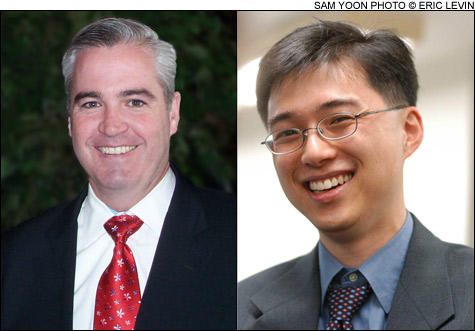
OUT WITH THE OLD: If Michael Flaherty hopes to parlay his preliminary success into a victory in November, he'll need some help from "New Boston." |
Michael Flaherty, having earned a spot Tuesday on the November ballot, starts his six-week push to the Boston mayoral final with a big problem. He needs Sam Yoon's voters, and to get them he needs Sam Yoon. That might be overstating the case, but not by much. Flaherty can't cobble together a majority of the vote without the so-called New Boston coalition of young progressives, immigrants, recent transplants to the city, and minorities. He might be able to win some of them over by himself — he has been courting them for quite a while — but cannot afford to devote the precious hours and resources to do it one voter at a time. As it stands, Flaherty's prospects don't look good. Things might have been different had Flaherty accomplished what he needed to do to convince the skeptics that he had a legitimate shot at beating Mayor Thomas Menino: keep Menino under 50 percent of the vote, while putting up a solid enough personal number to give the impression he is steadily adding voters to his bandwagon. For a while on Tuesday, it looked like it might happen. As late as 9:35 pm, when Flaherty entered the packed Venezia Waterfront Restaurant in Dorchester to the blare of Dropkick Murphys, the incomplete vote tally had it Menino 47 percent, Flaherty 29 percent. When it was all over, though, the Menino machine had proven its worth. The mayor not only squeaked over 50 percent, but more than doubled Flaherty's total ? while Flaherty ended up barely edging Yoon. Flaherty would surely be helped, then, by an enthusiastic endorsement from Yoon. But Yoon seems to be in no hurry to make that decision. Instead, Yoon's agenda is perhaps topped by whatever best serves Yoon's 2013 mayoral hopes. If Menino bests Flaherty in November, but chooses to retire four years from now, Yoon has to be considered an early front-runner to take one of the top two spots in the inevitably fragmented 2013 mayoral preliminary. (His opponent may well be At-Large City Councilor John Connolly, whose impressive, almost dominating first-place finish Tuesday makes him an instant mayoral contender.) Walking away quietly from the Menino-Flaherty showdown might be better for those prospects than getting caught up in it. New friends
Flaherty graciously commended Yoon and fourth-place finisher Kevin McCrea, but did not explicitly ask for their supporters' votes during his brief election-night speech in the Venezia ballroom.
Read more |
| Review: I Hope They Serve Beer in Hell
September 23, 2009 at 1:50 pm
|
| Tucker Max serves up arrogance, misogyny, poo jokes
The mantra "What would Tucker do?" gets bandied about in this boys-gone-wild silliness from Bob Gosse. |
| Leon Kirchner, 1919–2009
September 23, 2009 at 1:48 pm
|
| In Memoriam
Craggy, tender, passionate, witty, rough-edged, lyrical, uncompromising, Leon Kirchner's music, so like the man himself, made an indelible impression. Even in his recent appearance at a 90th-birthday tribute concert at the Isabella Stewart Gardner Museum, the old fire and wit, the frankness and the refusal to sentimentalize, were there. |
| The Bigmouth strikes again
September 22, 2009 at 7:40 pm
|
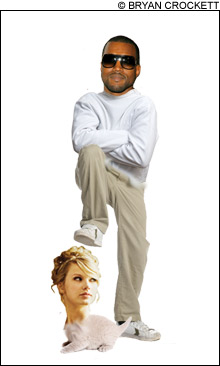
| Kanye acts like himself; nation loses shit
Given all the conflicting emotions, it was tough to form an opinion on Kanye West's VMA bum rush against Taylor Swift.
Given all the conflicting emotions, it was tough to form an opinion on KANYE WEST's VMA bum rush against TAYLOR SWIFT. My natural revulsion against Kanye's ego was counteracted by my love of mayhem and disruption, and my disdain for cutesy teen-pop singers was tempered by the pitiful welling of confusion and heartbreak in Taylor's big, beautiful whatever-colored eyes. I'd call it a wash.The crowd was conflicted too — there was plenty of applause mixed in with the boos. I'd imagine about a third of it was from Beyoncé supporters, a third was from people just excited to see Kanye and Taylor Swift on stage, and the rest was the sound of MTV execs high-fiving each other because they've got a new "most shocking moment" to pad out the weeks of self-gratification that traditionally hype up the ceremony ? Diana Ross wiggling Lil Kim's boob has been number one for way too long. Although this isn't West's first spirited outburst, it may be the first that can't be shrugged off with a clucking "Oh, that Kanye." His fatal miscalculation this time, it seems, was interrupting the sure-to-be-adorable speech of Taylor Swift, the industry's most blameless white-bread innocent. Grabbing the mic from some goofus no-name dance crew at the 2006 MTV Euro awards was one thing, but interrupting the proudest moment of a wide-eyed celebrity teen bumpkin is enough to make even the president call you a jackass. Katy Perry said it best, via Twitter: "FUCK U KANYE. IT'S LIKE U STEPPED 0N A KITTEN." Please note that this is not only the first-ever instance of Katy Perry saying something best, it's also the first time something has been said best via Twitter. Or perhaps I'm giving Katy too much credit — I figured she was speaking metaphorically, but maybe I tuned in late and missed the part where a cognac-swigging Kanye trod over some mewling kittens on the red carpet. Oh, that Kanye! As I write this, Ye is already up to four apologies: two on his blog, one on Jay Leno, and one via telephone directly to Swift. (Extrapolating from the current rate of two apologies per day since the incident, I expect he'll be somewhere around number 16 by the time you read this, so surely he'll be reaching stratospheric levels of public forgiveness, and I'll just look like an asshole for still making fun of him.)
Read more |
| Black beauty
September 22, 2009 at 7:36 pm
|
| Fences, plus The Savannah Disputation and Mister Roberts
August Wilson pioneered a magical realism all his own.
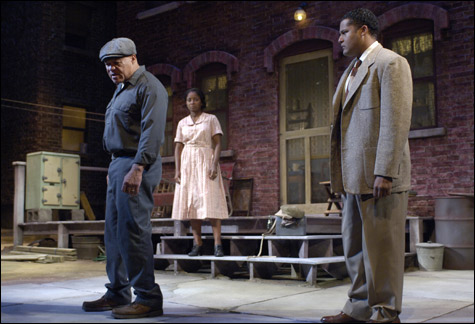
FENCES It's the combination of the mundane and the miraculous that makes August Wilson's play not only hard-hitting but transcendent. |
August Wilson pioneered a magical realism all his own. In the late dramatist's cycle of 10 plays chronicling decade by decade the African-American experience of the 20th century, the kitchen sink is oftener than not limned by a halo of the supernatural. And FENCES, among the most traditional yet powerful of the playwright's works, is no exception. Set on a scruffy patch of yard off a Pittsburgh alley in 1957, Wilson's first Pulitzer winner centers on an embittered titan of a garbage collector who claims to have wrestled down the Devil and also includes a mentally damaged character whose perceived connections to Heaven turn out to be quite genuine. As in Wilson's other finest works, it's this combination of the mundane and the miraculous ? interwoven in a rich tapestry of black speech that draws on the church, the street, and the blues ? that makes the play not only hard-hitting but transcendent. And slammed here by the bat of the Huntington Theatre Company (at the Boston University Theatre through October 11), the baseball-centric drama soars. The Huntington early on became a way station for Wilson's plays as they traveled toward Broadway, their author, with his familiar cap and cigarette, rewriting in restaurants that included Ann's Cafeteria (now Betty's Wok and Noodle) near the BU Theatre. Fences made its pilgrimage before the Huntington got in on the act, but with this production the Boston troupe mounts its ninth play of Wilson's sweeping cycle. Frequent Wilson collaborator Kenny Leon is at the helm, with Wilson vet John Beasley filling James Earl Jones's shoes if not quite supplying his thunder as Herculean hauler of refuse Troy Maxson, and Crystal Fox turning in a subtly devastating performance as Rose, the wife in whose compassionate embrace Troy nightly tries "to blast a hole into forever." There are echoes of Shakespeare and Arthur Miller in Wilson's story of a tough father both thwarting and shaping his sons at a time when the winds of social change were just starting to blow. A sharecropper's son who weathered the black diaspora north, a term in prison, and the hardening disappointment of having been a gifted Negro League ballplayer before Jackie Robinson broke the color barrier, Troy disparages his jazz-musician son from an earlier marriage and squelches any chance his son with Rose might have for a football scholarship that he assumes will lead, like his own sports prowess, nowhere. Troy's motives are both protective and mean-spirited, spurred by dueling fears that the son too will strike out against the white Establishment and that he'll outstrip his galvanic old man. And Beasley (though he flubs a few lines) captures both the brute, self-forged morality of Troy and the frisky raconteur with "some Uncle Remus" in him.
Read more |
| Play by Play: September 25, 2009
September 22, 2009 at 7:32 pm
|
| Plays from A to Z
Boston's weekly theater schedule
OPENING BASH | Theatre on Fire opens its fifth-anniversary season at the Charlestown Working Theater with Neil LaBute's triptych of one-acts in which characters reveal their most horrendous acts to unseen interlocutors. In A Gaggle of Saints, two Boston College students in evening dress recount a trip to New York for a "bash" at the Plaza Hotel that ends in a different kind of bash, the beating-to-death of a gay man. Iphigenia in Orem finds a Utah businessman cornering a strangely inert stranger in a hotel lobby at a convention for the purpose of talking his ear off. And in Medea Redux, a woman who's been convicted or murder tells how at 13 she was seduced by her high-school English teacher. Darren Evans directs. | Charlestown Working Theater, 442 Bunker Hill St, Charlestown | 866.811.4111 | October 2-17 | Curtain 7:30 pm Thurs-Sat | $20; $15 Thurs THE CARETAKER | Nora Theatre Company opens its 2009?2010 season with Harold Pinter's 1960 enigma, in which Aston, who's had electroshock treatment, brings the homeless and difficult Davies back to his ramshackle apartment and the two fence with each other, Aston trying to please Davies while the audience wonders why. It gets still more complicated when Aston's younger brother, Mick, enters the picture. With John Kuntz as Aston, Michael Balcanoff as Davies, and Joe Lanza as Mick; Daniel Gidron directs. | Central Square Theater, 450 Mass Ave, Cambridge | 866.811.4111 | October 1?November 1 | Curtain 7:30 pm Thurs | 8 pm Fri | 2 + 8 pm Sat | 2 + 7 pm [evening October 4] Sun | $35; $25 seniors; $20 students GREAT EXPECTATIONS | 11:11 Theatre Company opens its season with something we don't recall seeing often, if at all: a stage version of Charles Dickens's classic about Pip, Magwitch, Estella, and the eternally disappointed Miss Havisham. The company collaborated on the adaptation. | Factory Theatre, 791 Tremont St, Boston |www.1111theatre.com| September 25?October 3 | Curtain 8 pm Thurs-Sat | 3 pm Sun | $15; $12 students, seniors KING LEAR | Actors from the London Stage ? i.e., actors from the Royal Shakespeare Company, the Royal National Theatre and the Globe Theatre ? makes its regular visit to Boston; the price is right, and if these guys can't do Lear, who can? | Wellesley College Theatre, Houghton Chapel, 106 Central St, Wellesley |www.theatre.wellesley.edu| September 24-26 | Curtain 7:30 pm Thurs-Sat | Free
Read more |
| Review: Bright Star
September 22, 2009 at 7:24 pm
|
| Jane Campion does Keats — sort of
"Bright star, would I were steadfast as thou art." That's the first line of a sonnet that John Keats did or did not write for Fanny Brawne, who was in either case the love of his brief life.
"Bright star, would I were steadfast as thou art." That's the first line of a sonnet that John Keats did or did not write for Fanny Brawne, who was in either case the love of his brief life. Keats described her as "monstrous in her behavior flying out in all directions, calling people such names — that I was forced lately to make use of the term Minx — this I think not from any innate vice but from a penchant she has for acting stylishly." Was this the proper helpmate of the most famous Romantic poet of all? Critics have debated that point for the past century and a half. In Bright Star, Australian director Jane Campion weighs in with an unequivocal yes. Her film, true to its title, is about Fanny rather than Keats.Keats and Fanny met late in 1818, when he was 23 and she 18. There was a great deal of posturing and teasing and mock-fighting between them, but it wasn't till April of 1819, when her family moved into Wentworth House (the other half of which Keats shared with his friend Charles Brown) in Hampstead, that both their love and Keats's poetry heated up. By the fall there was an understanding between them — but Keats had no income and was too poor to marry. The following February, he coughed up the notorious drop of arterial blood that signaled he had contracted tuberculosis. Within a year, he was dead, in Rome, where his friends had sent him for the warmer climate. Bright Star opens with close-ups of Fanny sewing (she was a stylish seamstress who made her own clothes) while on the soundtrack we hear the "Hampstead Heathens" vocalizing, Swingle Singers-style, the Romance from Mozart's Gran Partita (the movement that Salieri salivates over in Amadeus). What follows is a bright (almost glossy), well-bred love story that, but for the tragic ending, could be a Jane Austen novel of female empowerment. Abbie Cornish is a knowing, Bond Girl?like Fanny whose emotional commitment is never in doubt, even when she can't bring herself to gush over her beloved's every line. Ben Whishaw, channeling his fey Sebastian Flyte from the 2007 Brideshead Revisited, loiters pale and haggard as a one-dimensional Keats untouched by philosophy or politics or his experience in the surgical practice at Guy's Hospital. Paul Schneider's very Scottish-sounding Brown is the villain who keeps them apart till Keats's TB kicks in, partly because he thinks Fanny's a flirt and an airhead and partly because he wants Keats for himself. Brown is the only member of Keats's circle who has more than a cameo, though there are affecting turns from Kerry Fox as the widowed Mrs. Brawne and Thomas Sangster and a scene-stealing Edie Martin as Fanny's younger brother and sister.
Read more |
| Love bug
September 22, 2009 at 7:08 pm
|
| Damián Ortega rides into the ICA
At the 2003 Venice Biennale, Damián Ortega presented what has become his signature sculpture, Cosmic Thing . He dissected a 1989 Volkswagen Beetle and suspended the individual parts in mid air so that they resemble a 3-D assembly diagram.
VIDEO: A preview of Damián Ortega's "Do It Yourself" at the ICA.
At the 2003 Venice Biennale, Damián Ortega presented what has become his signature sculpture, Cosmic Thing. He dissected a 1989 Volkswagen Beetle and suspended the individual parts in mid air so that they resemble a 3-D assembly diagram.It was an eye-catching floating monument to the end of manufacture of the Bug (not to be confused with the "New Beetle," which has been produced since 1994). It spoke of Ortega's native Mexico City, where the car was ubiquitous, kept on the road with parts cannibalized from other VWs. Ortega, who now splits his time between Mexico and Berlin, also saw it as representing the legacy of the Nazis. Adolf Hitler commissioned the Volkswagen as an affordable, durable "people's car" — exactly why the Beetle thrived in Mexico. Dividing the car into its component parts was Ortega's metaphor for atoms that make up molecules, for rocks and gases that combine to form galaxies, for the relationship between individuals and their societies. But mostly, it's a catchy cool showcase for a famously cute car. Included in "Do It Yourself," a 13-year survey of Ortega's art at the Institute of Contemporary Art, Cosmic Thing exemplifies both the strengths and the weaknesses of his style of conceptually based sculpture — and much conceptual art today. He hopes we'll read a lot into that Beetle, but he offers little to lead you to Mexico or Nazis or the cosmos. You're just supposed to recognize these associations and know that they are the intended ones. In practice, it works like a Rorschach test. You might find yourself making lots of associations; you might find yourself thinking it's just a car. The more I stare, the more I walk among its parts hovering in the air, the more the associations slide off and even the neato display begins to feel like a gimmick. Ortega began his artistic career drawing political cartoons for Mexican newspapers and magazines. But he grew frustrated by the short shelf life of his topical cartoons. "The next day the caricature maybe is less important," he tells me at the ICA's press opening. "And after three years, the cartoons have lost the life. It's a quality. It's like a fruit. But I would like to have a second reading of the same piece." So, in the mid 1990s, he transitioned to fine art. Still, the sculptures seen here in his first museum retrospective offer evidence of a lasting desire to analyze and critique society.
Read more |
| True romance
September 22, 2009 at 7:02 pm
|
| Jane Campion beams on her Bright Star
Bright Star is the best movie ever made about John Keats, the great Romantic poet who died at the age of 25. According to the Internet Movie Database, however, it is also the only one.
Bright Star is the best movie ever made about John Keats, the great Romantic poet who died at the age of 25. According to the Internet Movie Database, however, it is also the only one."Really?" says Jane Campion, who has addressed equally tough topics in Sweetie (1989), An Angel at My Table (1990), and The Piano (1993). "Someone told me that there had been another one. But then again, there aren't many films about any poets at all. Except maybe Coleridge in Pandæmonium (2000)." Perhaps that's because the subjective experience of writing poetry does not readily lend itself to the objective medium of film. Also, Bright Star's love story between Keats and Fanny Brawne never progresses much beyond the hand-holding stage, which could be a hard sell in this age of graphic sex on screen. Campion herself had doubts about the project. "I thought, 'This has to be the worst idea for a movie.' But I was drawn to the love story. And I didn't think it would be a problem making it work on screen, even though it wasn't consummated. When a love affair is consummated in the first 10 minutes of a film, all the tension is lost. I find the anticipation more erotic. And as for showing the writing process, that's partly why I chose to tell the story from the point of view of Fanny. She, like me, was trying to learn about poetry and how it was written. So she serves as a way to enter that process." Campion first encountered Keats's poetry when she was 18 ? about the same age Brawne was when she met the poet. "I had this ridiculous professor who thought there were many different interpretations of a poem. I was fascistic and thought there was only one. That it was a puzzle to be cracked. Later, I learned that the experience of immersing oneself in beauty without the need for final answers was more rewarding." She came to that conclusion while doing research for the poetically inclined heroine of her previous film, the unfairly maligned thriller In the Cut (2003). Campion was reading Andrew Motion's 1999 biography of Keats, and she was moved not only by the tragedy of his life and love but also by Keats's concept of "Negative Capability." "That was the notion we fell back on whenever we got stuck. The ability to be 'in uncertainties, Mysteries, doubts without any irritable reaching after fact & reason.' "
Read more |
| Review: The Walkmen at Middle East
September 22, 2009 at 6:53 pm
|
| The Walkmen, live at Middle East downstairs on September 18, 2009
It was strange to see the sparse instrumentation from which NYC's The Walkmen drew their atmospheric, honey-dipped sound last Friday at the Middle East. |
| Smaller, bigger, better
September 22, 2009 at 6:41 pm
|
| Boston Ballet's fourth 'Night of Stars'
Is Boston in the midst of a ballet boom? You could certainly believe that if you attended Boston Ballet's fourth annual season-opening gala last Saturday.
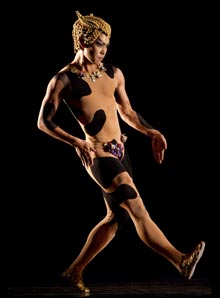
Is Boston in the midst of a ballet boom? You could certainly believe that if you attended Boston Ballet's fourth annual season-opening gala last Saturday. The company is trumpeting its move from the 3600-seat Wang Theatre to the more intimate 2600-seat Opera House as the beginning of a new era. Five soloists — Kathleen Breen Combes, Pavel Gurevich, Melissa Hough, Misa Kuranaga, and James Whiteside — have been promoted to principal (you might wonder how the company can afford 11 principals when it had just seven last season), and 17-year-old Whitney Jensen, already a multiple-competition winner, has been added to the corps. The Paris Opera Ballet–style défilé — a kind of company introduction in which the dancers come on stage one by one, each to the cheers of his or her fans — that graced the first two galas is back as well. There was more energy on stage than there was last year, and also in the sold-out house.The program was the usual mix of highlights past and future with a couple of novelties, a bit of home choreography, and a pair of guest stars. From 2007–2008 there was part three of Helen Pickett's Eventide, and from the past season, Jirí Kylián's Petite Mort, the opening waltz movement from George Balanchine's Diamonds, the Rose Adagio from The Sleeping Beauty, and Vaslav Nijinsky's Afternoon of a Faun. Hough and Whiteside choreographed and danced Zero Hour; Jensen appeared with corps members Isaac Akiba and Jeffrey Cirio in an excerpt from Marius Petipa's 1900 ballet Harlequinade; principal Larissa Ponomarenko solo'd in an excerpt from Aleksandr Radunsky's 1961 The Little Humpbacked Horse. The two pas de deux were from classical ballets that will be given this season: Giselle, with company principals Erica Cornejo and Nelson Madrigal, and Coppélia, with the Royal Ballet's Alina Cojocaru and Johan Kobborg. The crowd pleasers were the Eventide excerpt, Pickett's In the Upper Room knockoff (complete with Philip Glass's rewrite of part of his Upper Room score), and Petite Mort, Kylián's unsettling essay on men and women set to the slow movements from Mozart's Piano Concertos Nos. 23 and 21. These showed off the company's command of a modern ballet vocabulary. The pas de deux made for a pallid contrast, Cornejo and Madrigal æthereal but emotionally neutral in Giselle, Cojocaru and Kobborg boasting the easy grace and artistry of mature professionals but, Cojocaru's 10-second unsupported balance on pointe aside (and she shouldn't have tried to repeat it), not much bravura.
Read more |
| How it feels to be something (back) on
September 22, 2009 at 6:36 pm
|
| The return of Sunny Day Real Estate
Sub Pop co-founder Jonathan Poneman still sounds amazed by the band he saw at Seattle's Crocodile Café back in 1993.
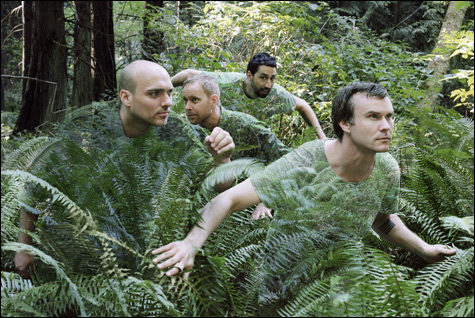
FINDING EMO: Sunny Day provide a definitive link between the DC punk scene that gave birth to "emocore" and the mainstream pop product it has since become. |
Sub Pop co-founder Jonathan Poneman still sounds amazed by the band he saw at Seattle's Crocodile Café back in 1993. "It was an immediately captivating thing," says Poneman over the phone from Sub Pop headquarters. "They were very exuberant players, [and] there was a certain maturity to the songwriting and the arrangements that, frankly, wasn't really that present in a lot of music that we were being exposed to at the time." All this from the head of a label that sought "world domination" on the back of a little Northwest strain of rock that came to be known as grunge. Poneman — who has helped introduce Nirvana, the Shins, Iron & Wine, the Postal Service, and Fleet Foxes to the world — had resolved then and there to sign Sunny Day Real Estate, and they hadn't even finished playing their second song. SDRE (who have reunited for a tour that hits the House of Blues on Monday) were supposed to be the next Nirvana — but for many in Seattle, they represented something entirely different. As four kids brought up on hardcore punk, they distanced themselves from the grunge game by taking a vibrant post-hardcore sound that emerged from DC and transforming it with a mix of technical wizardry and frontman Jeremy Enigk's haunting falsetto into an epic, pop-ready sound. Their style was unique and arresting, especially to a city that had suffered years of Mudhoney knockoffs. "To me they're this band that represents exactly what I embraced," says KEXP Seattle DJ Marco Collins, an early supporter. "It's the stuff that's edgy as hell, but it's still beautiful at the same time." Although Sunny Day never enjoyed the same success as Nirvana, listeners weren't quite saying nevermind, either. The band's debut album, 1994's Diary, pushed them into the national spotlight thanks to consistent airplay of videos for "Seven" and "In Circles" on MTV, and it was the second-biggest seller for Sub Pop at the time. Their homonymous sophomore album is the stuff of myth among hardcore SDRE fans. With its barren pink cover and lack of any formal name — it's often referred to as "The Pink Album," though the label leans toward "LP2" — the nine-song record is as shrouded in mystery as it is forthright in its appeal. (Sub Pop recently reissued SDRE's first two albums, in conjunction with the reunion.)
Read more | | | 
|

.jpg "0909_slotmachine_home")

No comments:
Post a Comment